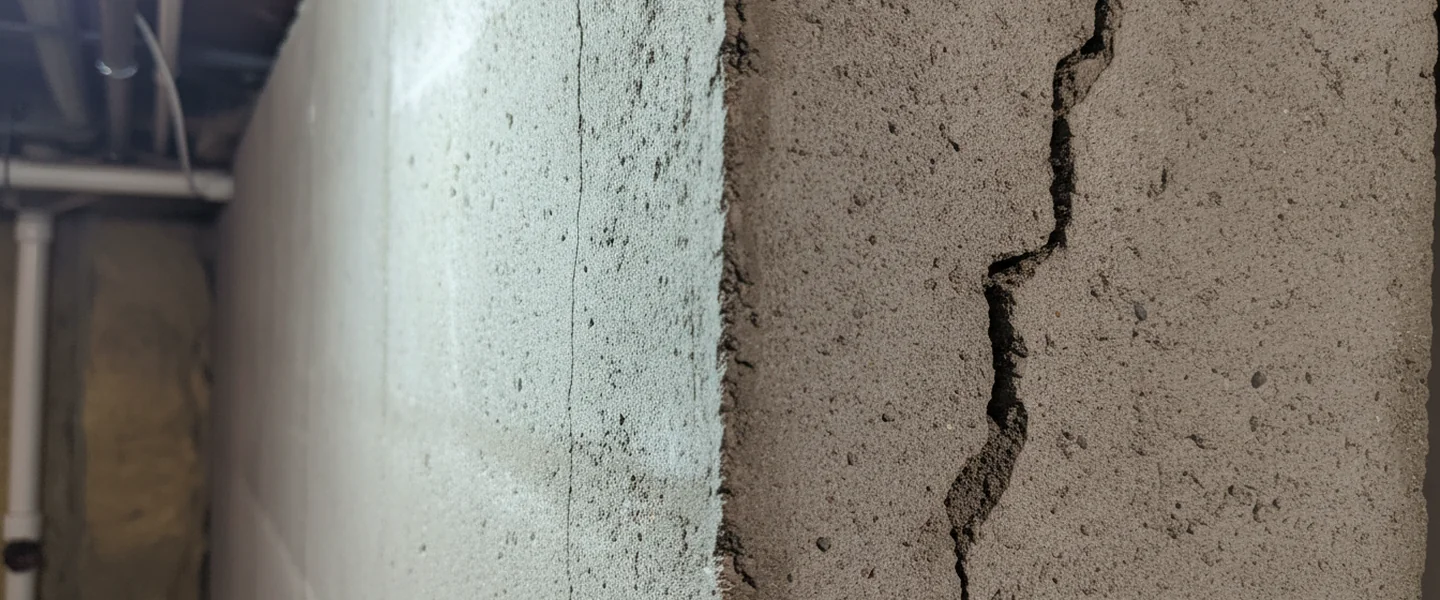
Hairline vs Structural Cracks: How to Tell the Difference
Locally based foundation repair specialists serving the Fairfax area and Northern Virginia.
- Licensed & Insured in Virginia
- Locally Owned, Fairfax-Based
- Lifetime Manufacturer Pier Warranty
- Free On-Site Structural Inspections
- Engineered Repair Plans
One of the most common calls we get from Fairfax-area homeowners is some version of “I have a crack in my basement wall — is this serious?” The honest answer is “it depends” — and the inspection visit settles it definitively. But there are visual signatures that distinguish cosmetic hairline cracks from structural cracks that need engineered repair, and any Fairfax-area homeowner who knows what to look for can make a more informed decision about whether to call for an inspection right away or schedule one at convenience.
What Makes a Crack “Hairline” (and Usually Cosmetic)
A hairline crack is, by definition, narrower than 1/16 inch — about the thickness of a credit card edge. In poured concrete foundation walls, hairline cracks are extremely common and usually result from concrete shrinkage during curing, minor seasonal expansion and contraction, or low-level settlement during the first few years after construction. They are vertical or diagonal, do not grow over time, do not leak water, and do not have any associated wall displacement.
In the Fairfax area, hairline cracks are present in virtually every concrete foundation wall built since 1950. They are not a structural concern by themselves. They do warrant attention if they begin to leak during summer thunderstorms — at that point the crack itself is still cosmetic but it has become a water entry path, and polyurethane crack injection is the right solution to stop the leak without any structural work.
What Makes a Crack “Structural” (and Worth Engineering Attention)
Structural cracks have one or more of the following signatures, and any one of them warrants a free inspection:
Width. Wider than 1/16 inch, particularly if the crack is wider at one end than the other (tapered). A 1/4 inch wide crack is almost always structural.
Pattern. Horizontal cracks at approximately mid-wall height are the classic signature of hydrostatic pressure bowing — the wall is being pushed inward by saturated clay soil. Stair-step cracks in CMU walls follow the mortar joints diagonally and are the classic signature of differential settlement or active clay shrink-swell movement.
Growth. Cracks that are visibly wider than they were six months ago, or cracks that you’ve marked with a pencil and watched expand, are active and warrant engineering review.
Displacement. The two sides of the crack are no longer flush — one side has shifted forward, backward, up, or down relative to the other. Any measurable displacement is structural.
Leaks. The crack actively transmits water during heavy rain. By itself this is not structural, but it warrants repair.
Associated symptoms. Doors and windows in the room above the crack no longer close properly, gaps are opening between the foundation and adjacent finishes, the floor has visible slope across the room.
The Five Crack Patterns We See Most in Fairfax-Area Homes
Vertical hairline cracks at corners. Almost always cosmetic. Often present from the original concrete cure. Address with paint or polyurethane injection only if they begin to leak.
Vertical cracks wider than 1/16 inch. Often indicate minor settlement — the foundation has moved slightly and the wall has cracked to accommodate the movement. Polyurethane injection seals the leak; if the movement is ongoing, the underlying cause (footing settlement on expansive clay, fill consolidation) needs to be addressed.
Horizontal cracks at mid-wall height. Classic bowing wall signature. The wall is being pushed inward by hydrostatic pressure from saturated red-clay subsoils outside. Common in Fairfax-area walkout basements and split-level lower stories built before 1975. Repair requires carbon fiber strap stabilization or wall anchors after engineering review.
Stair-step cracks in CMU walls. The crack follows the mortar joints diagonally, stepping across multiple blocks. Almost always indicates differential settlement — one section of the foundation has moved relative to another. Very common in older Annandale brick ramblers, cut-and-fill townhomes in Burke, and Centreville subdivisions. Repair typically requires engineered piering.
Diagonal cracks at corners. Usually indicate settlement at one corner of the foundation. The pattern of the crack tells you which direction the corner has moved. Repair scope depends on whether the settlement is ongoing or dormant.
How to Tell If a Crack Is Active or Dormant
The simplest field test: mark each end of the crack with a thin pencil line and date the marks. Re-measure in 3-6 months — Northern Virginia’s seasonal shrink-swell cycle means an active clay-driven crack will often progress most visibly between late spring and late summer. If the marks are still at the ends of the crack, the crack is dormant. If the crack has extended past the marks, it is active. A more precise method uses crack monitors — small plastic gauges glued across the crack that measure displacement over time. We use them on jobs where the active-versus-dormant distinction changes the repair scope.
What to Do Before You Call a Contractor
Take clear, well-lit photos of every visible crack from multiple angles. Use a tape measure as a reference for scale. Note the location (interior or exterior face of the foundation, which wall, what height from the floor). Mark each end of the crack with a pencil so you can monitor for growth. Note any associated symptoms in the rooms above — door operation, window operation, floor slope, gaps between walls and floors. The contractor will want all of this information and having it ready makes the inspection visit more productive.
Why Bleach, Caulk, and Hydraulic Cement Don’t Work for Foundation Cracks
Homeowners often try DIY repairs first. None of the common DIY approaches actually work for Fairfax-area foundation cracks. Caulk and surface sealants fail under hydrostatic pressure within a year or two. Hydraulic cement plugs the crack on the interior face but does not address the full depth of the crack and does not stop water from migrating around the patch. Bleach does nothing for concrete cracks (it’s a mold treatment, not a structural repair). The right repair is pressure-injected polyurethane or epoxy that fills the entire depth of the crack from interior to exterior face.
Fairfax-Specific Considerations
Northern Virginia’s summer thunderstorm season puts hydrostatic pressure on basement walls in short, intense bursts. Cracks that would be cosmetic in a drier climate become water entry paths here within a single season. Cracks that would be slow-progressing structural concerns in a drier climate become emergencies here because every storm event adds more lateral load on a compromised wall. The right approach is to address any structural crack before the next summer storm season, not after.
Walkout-basement homes and split-levels get particular attention. A horizontal crack in the buried uphill wall of a walkout basement, particularly one with stair-step cracking propagating outward, is the early warning sign of active clay-driven inward movement — and the right repair involves engineered carbon fiber stabilization plus exterior drainage improvements, not cosmetic injection.
Common Misconceptions About Foundation Cracks
“Every house has cracks — mine isn’t special.”
Hairline cracks are common; structural cracks are not, and confusing them costs Fairfax-area homeowners real money. The inspection visit settles which category you have.
“I can just paint over it.”
Paint doesn’t seal a leaking crack and does nothing for structural cracks. It also hides the crack from your own monitoring, making it harder to know if it’s growing.
“If it doesn’t leak, it’s not a problem.”
Some structural cracks don’t leak until they’ve progressed considerably. Width, growth, displacement, and associated symptoms matter more than the presence of water.
“My home inspector said it was fine.”
Home inspectors are generalists. A specific structural concern warrants a specialist evaluation, particularly on older homes or homes on documented expansive-clay soils common in much of Fairfax County.
Questions to Ask the Contractor
- Is this crack structural or cosmetic, and what specific signatures lead you to that conclusion?
- What’s the underlying cause — hydrostatic pressure, settlement, clay shrink-swell, frost heave, original construction defect?
- Is the crack active or dormant, and how did you determine that?
- What’s the right repair method given the cause, and why?
- Will the repair require engineering documentation or a Fairfax County permit?
- What’s the warranty on the repair, and is it transferable?
Bottom Line
Hairline cracks under 1/16 inch are usually cosmetic in Fairfax-area concrete foundations. Cracks wider than that, cracks that are growing, cracks that show stair-step or horizontal patterns, and cracks with associated symptoms (door problems, sloping floors, displacement) warrant a free inspection. Call (571) 740-0342 and we’ll measure displacement, photograph the crack, identify the underlying cause, and tell you whether the right answer is cosmetic injection, structural reinforcement, or engineered piering. The visit is free and the inspection report is yours to keep regardless of whether you hire us.
Service Areas We Cover
We serve Fairfax and the entire Northern Virginia region. Click your suburb for local details and our typical findings in your housing stock:
Free Foundation Inspection in Fairfax
Same-week appointments. No high-pressure sales. Serving Fairfax and surrounding areas including Vienna, Oakton, Burke, Annandale, Centreville, Chantilly, McLean, Springfield.